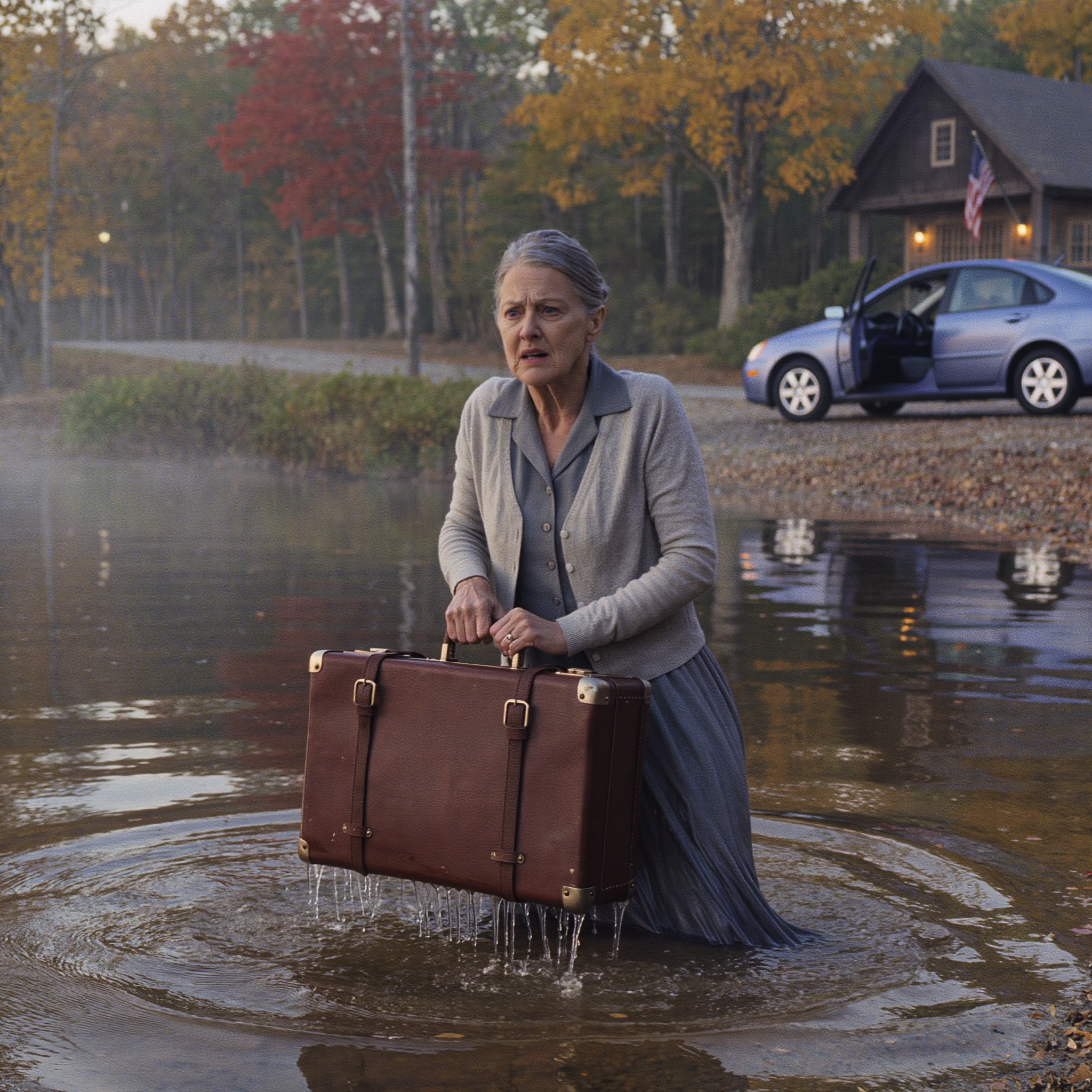
My daughter-in-law. My son’s wife. A murderer.
I couldn’t process it. I couldn’t understand it.
Eloise put her hand on mine.
“You did the right thing. You saved a life today.”
But it didn’t feel like that. It felt like I had uncovered something terrible. Something I couldn’t push back into the darkness. Something that would change everything forever.
Two hours passed before a doctor came out to talk to me. He was young, maybe thirty-five. He had deep dark circles under his eyes and hands that smelled like antibacterial soap.
“The baby is stable,” he said. “For now. He’s in the neonatal intensive care unit. He suffered severe hypothermia and aspirated water. His lungs are compromised. The next forty-eight hours are critical.”
“Is he going to live?” I asked. My voice sounded broken.
“I don’t know,” he said with brutal honesty. “We’re going to do everything we can.”
The police arrived half an hour later. Two officers—a woman in her forties with her hair in a tight bun and a younger man who took notes. The woman introduced herself as Detective Fatima Salazar. She had dark eyes that seemed to see right through lies.
They asked me the same questions over and over from different angles. I described the car, the exact time, Cynthia’s movements, the suitcase, everything. Fatima stared at me with an intensity that made me feel guilty, even though I’d done nothing wrong.
“And you’re sure it was your daughter-in-law?”
“Completely sure.”
“Why would she do something like that?”
“I don’t know.”
“Where is she now?”
“I don’t know.”
“When was the last time you spoke to her before today?”
“Three weeks ago. On the anniversary of my son’s death.”
Fatima wrote something down. She exchanged a look with her partner.
“We’re going to need you to come to the station to make a formal statement tomorrow, and you cannot contact Cynthia under any circumstances. Do you understand?”
I nodded.
What was I going to say to her anyway? Why did you try to kill a baby? Why did you throw him in the lake like trash? Why? Why? Why?
The officers left. Eloise came back with a blanket and a cup of hot tea.
“You should go home,” she said. “Get some rest. Change your clothes.”
But I couldn’t leave. I couldn’t leave that baby alone in the hospital—that baby I had held against my chest, who had breathed his last gasp of hope in my arms.
“I’ll stay,” I said.
I stayed in the waiting room. Eloise brought me dry clothes from the hospital storage—nurse’s pants and a T-shirt that was way too big. I changed in the bathroom. I looked at myself in the mirror. I looked like I had aged ten years in one afternoon.
I didn’t sleep that night. I sat in that plastic chair watching the clock. Every hour I got up and asked about the baby. The nurses gave me the same answer.
“Stable. Critical. Fighting.”
At 3:00 in the morning, Father Anthony showed up, the priest from my church. Someone must have called him. He sat next to me in silence. He didn’t say anything for a long time. He was just there.
Sometimes that’s all you need—a presence. Proof that you’re not completely alone in hell.
“God tests us in many ways,” he finally said.
“This doesn’t feel like a test,” I replied. “It feels like a curse.”
He nodded. He didn’t try to convince me otherwise.
And I appreciated that more than any sermon.
When the sun began to rise, I knew that nothing would ever be the same. I had crossed a line. I had seen something I couldn’t unsee. And whatever came next, I would have to face it. Because that baby, that tiny being fighting for every breath in the next room, had become my responsibility.
I hadn’t chosen it. But I couldn’t abandon him either. Not after pulling him from the water. Not after feeling his heartbeat against mine.
The sunrise came without me even noticing. Light streamed through the waiting room windows, painting everything a pale orange. I had spent the entire night in that plastic chair. My back was aching. My eyes burned. But I couldn’t leave.
Every time I closed my eyes, I saw the suitcase sinking. I saw that still little body. I saw the purple lips.
Eloise appeared at 7:00 in the morning with coffee and a sandwich wrapped in foil.
“You need to eat something,” she said, putting it in my hands.
I wasn’t hungry, but I ate anyway because she just stood there waiting. The coffee was too hot and burned my tongue. The sandwich tasted like cardboard, but I chewed and swallowed. I pretended I was a normal person doing normal things on a normal morning.
“The baby is still stable,” Eloise said, sitting next to me. “His body temperature is rising. His lungs are responding to treatment. It’s a good sign.”
“Can I see him?”
She shook her head.
“Not yet. Only immediate family. And we don’t even know who the family is.”
Family.
The word hit me like a stone.
That baby had to have a family. A mother—Cynthia. But she had tried to kill him. So who was the father? Where was he? Why hadn’t anyone reported him missing?
The questions piled up in my head with no answers.
At 9:00, Detective Fatima came again. She was alone this time. She sat across from me with a folder in her hands. Her expression was hard, inquisitive. She looked at me as if I were the suspect.
“Betty, I need to ask you a few more questions,” she said, opening the folder.
“I already told you everything I know.”
“I know, but some inconsistencies have come up.”
“Inconsistencies?”
The word floated between us like an accusation. I felt my stomach tighten.
“What kind of inconsistencies?”
Fatima pulled out a photograph. She placed it on the small table between us.
It was Cynthia’s car, but it was in a parking lot, not by the lake.
“This photo was taken by a security camera at a supermarket thirty miles from here yesterday at 5:20 in the afternoon.”
5:20. Ten minutes after I saw her by the lake.
Impossible.
I looked at the photo more closely. It was her car—license plate and all.
“But it can’t be. There must be a mistake,” I said. “I saw her. I was there. I saw her throw the suitcase.”
“Are you completely sure it was Cynthia? How close were you?”
I swallowed hard.
“A hundred yards. Maybe more. I saw her from behind most of the time. The gray dress. The dark hair. The silver car. I was sure,” I said, but my voice sounded less convincing now.
Fatima leaned forward.
“Betty, I need you to be honest with me. What is your relationship with Cynthia? Do you get along?”
And there it was. The real question—the one I had been waiting for since the police showed up.
Because we didn’t get along. We had never gotten along. From the day Lewis introduced me to her, I knew something was wrong with her. She was too perfect, too calculating, too interested in the money Lewis made as an engineer.
“We’re not close,” I admitted.
“Do you blame her for your son’s death?”
“What?” My voice was too loud, too defensive.
“It’s a simple question. Do you blame Cynthia for Lewis’s death?”
The accident. That’s what everyone called it. Lewis was driving home after dinner with Cynthia. It was raining. The car skidded. He crashed into a tree. Lewis died on impact. Cynthia walked away with minor scratches.
It always seemed strange to me. It always seemed convenient. But I never had proof. Just a heartbroken mother looking for someone to blame.
“I don’t see what that has to do with the baby.”
“It has everything to do with it,” Fatima said, closing the folder. “Because we haven’t been able to locate Cynthia. She’s vanished. Her house is empty. Her phone is off. And you are the only person who claims to have seen her yesterday.”
Her words fell on me like ice water.
She was accusing me. Not directly, but the insinuation was there, clear as day. She thought I had made it all up—that I had found the baby some other way and was blaming Cynthia out of revenge.
“I didn’t lie,” I said through clenched teeth. “I saw what I saw.”
