“Then we need to find Cynthia, and fast. Because if she’s that baby’s mother, he’s in serious danger. And if she’s not, then we have an even bigger mystery on our hands.”
Fatima stood up. She handed me a card with her number.
“If you remember anything else, any detail, call me.”
She left, leaving me with more questions than answers.
I sat there with the card in my hand, wondering if I was losing my mind. I had seen Cynthia. I was sure of it. But now doubt was seeping in like poison.
What if I had been wrong? What if it was someone else? What if my grief and resentment had made me see what I wanted to see?
Father Anthony returned at noon. He held a rosary in his hands.
“Shall we pray?” he asked.
“I’m not very religious. I never was. But at that moment, I needed something bigger than myself. Something to tell me I wasn’t alone in this.”
I nodded. We prayed together in low voices. The familiar words calmed me, even if I didn’t understand how they worked. When we finished, I felt a little less broken.
“The police think I’m lying,” I told him.
“The truth always comes to light,” he replied. “Even if it takes time.”
But we didn’t have time. That baby was fighting for his life. And somewhere, Cynthia was hiding or running or planning her next move.
At 3:00 in the afternoon, a different doctor came to see me. A woman this time, older, with thick glasses and a serious expression.
“We need your consent to run some tests on the baby,” she said.
“I’m not family.”
“We know, but you’re the only responsible person right now. Social services is on the way, but in the meantime, we need to act. The baby needs blood tests. We need to know if he has any medical conditions, if he was exposed to drugs, if he has injuries we haven’t detected.”
I signed the papers. I didn’t even read them completely. I just wanted them to do whatever was necessary to save him.
Two hours later, the social worker showed up.
Alene.
She was young. Too young for that job, I thought. Maybe twenty-five. Short hair, gray suit, a professional smile that didn’t reach her eyes.
“Mrs. Betty,” she said, sitting next to me. “I need to ask you some questions about your situation. I understand you found the baby.”
The story again. The questions again. But Alene was different. She didn’t look at me with suspicion. She looked at me with pity, which was worse somehow.
“Do you live alone?” she asked.
“Yes.”
“Do you have a stable income?”
“I have my late husband’s pension and some savings.”
“Criminal record?”
“No.”
“Mental health issues? Depression? Anxiety?”
I hesitated.
After Lewis died, I took antidepressants for three months. My doctor said it was normal—that grief sometimes needs chemical help. I stopped when I started to feel better.
“I had depression after my son’s death,” I admitted. “But it’s over now.”
Alene wrote something down. I couldn’t see what.
“The baby will need a temporary home when he’s released from the hospital,” she said. “If he’s released. Social services will look for certified foster families. In the meantime, he will remain in state custody.”
State custody.
Those words broke something inside me. That baby I had held against my chest, who had breathed his first breath of life in my arms, was going to be handed over to strangers. To assistants. To people who would see him as just another case file, just another number.
“What if I wanted to…” The words came out before I could stop them. “What if I wanted to take care of him?”
Alene looked at me—surprised, then skeptical.
“Mrs. Betty, you’re sixty-two years old. You’re not a certified foster parent. You have no legal relationship to the baby. And you are involved in an active criminal investigation.”
“I didn’t do anything wrong. I saved his life.”
“I know. But the system has protocols. The child’s best interest comes first. And frankly, your age and your recent emotional situation are factors we have to consider.”
I felt like I had been slapped.
Too old. Too unstable. Too broken.
Maybe she was right. Maybe it was crazy to even think about it. But when I closed my eyes, all I saw was that fragile little body. And I knew that no one else in the world would love him like I could.
That night, I went home for the first time in thirty-six hours. Eloise convinced me. She said I needed to shower, to sleep in a real bed, that the baby would be fine, that they would call me if anything changed.
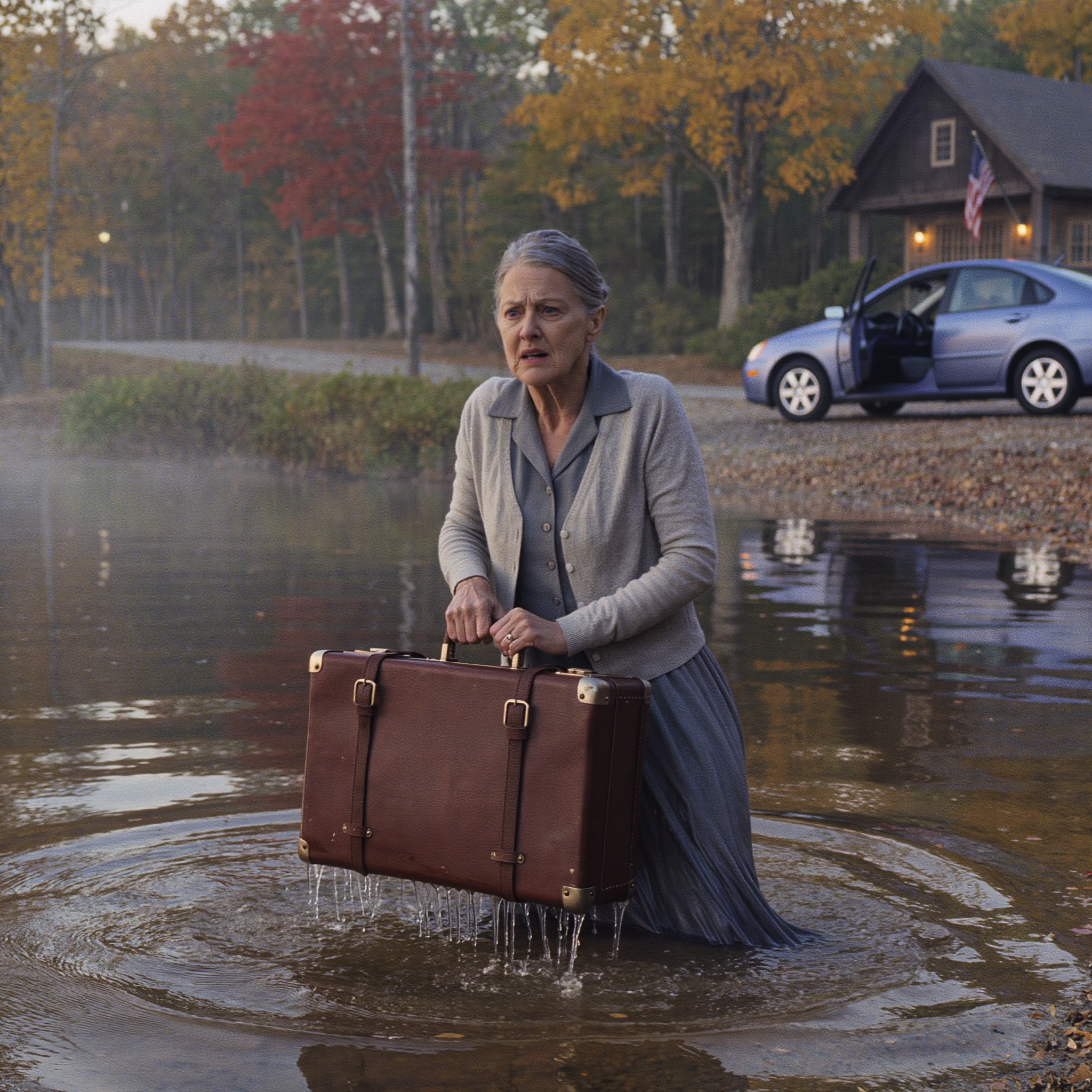
I drove home as the sun was setting. The lake shimmered to my right. I stopped at the same spot where I had seen Cynthia, where I had pulled out the suitcase. I got out of the car. I walked to the shore.
The suitcase was gone. The police had taken it as evidence. But I could see exactly where it had been. I could see my own footprints in the dried mud.
I stood there as darkness fell, wondering if I would ever know the truth. Wondering if Cynthia was watching from somewhere. Wondering what the hell had really happened.
And then my phone rang.
It was the hospital. My heart stopped.
“Mrs. Betty,” Eloise’s voice said, “you need to come back now.”
I drove back to the hospital, breaking every speed limit. My hands trembled on the steering wheel. My heart was beating so loud I could hear it over the engine.
Eloise hadn’t given any details on the phone. She had just said to come back now. Those two words were enough to fill my head with the worst-case scenarios.
The baby had died. It had to be that. Why else would they call me so urgently? He had fought for two days, and finally his little body had given up. It hadn’t been enough. I hadn’t been enough. I had been too late.
I parked crookedly, taking up two spots. I ran toward the emergency room doors. Eloise was waiting for me at the entrance. Her expression was serious, but there was something else—something I couldn’t decipher.
“He’s alive,” she said immediately, as if she knew exactly what I was thinking. “The baby’s alive. But you need to come with me.”
She led me down hallways I didn’t know. We went up to the third floor. We passed the neonatal intensive care unit. We kept walking. Finally, we reached a small conference room.
Inside were Detective Fatima, Alene the social worker, and a man I didn’t know. He was older, maybe sixty. He wore a dark suit and glasses. He had the face of a lawyer.
“Please sit down,” Fatima said, pointing to a chair.
I sat. My legs felt like jelly. Everyone was looking at me with an intensity that made me want to run.
“We received the results of the baby’s DNA test,” Fatima said. Her words fell like stones into still water.
DNA.
I didn’t understand why they had done that. What were they looking for?
“And?” I asked when the silence became unbearable.
Fatima exchanged a look with the man in the suit. He nodded.
She opened a folder and took out several papers. She placed them in front of me.
“The baby is a boy. He was born approximately three days ago, according to medical tests.” Fatima paused. “And, Betty, he’s your grandson.”
The world stopped.
The words didn’t make sense. I heard them, but my brain refused to process them.
My grandson.
Impossible.
Lewis died six months ago. He didn’t leave any children. No pregnancy. Nothing.
“That’s impossible,” I whispered.
“The results are conclusive,” said the man in the suit. “I’m Dr. Alan Mendes, a specialist in forensic genetics. We ran the tests twice to be sure. The baby shares approximately twenty-five percent of his DNA with you. He is definitively your biological grandson. Son of your son Lewis.”
Son of Lewis.
My Lewis.
I felt as if someone had hit me in the chest with a hammer. Lewis had a son. A son he never knew. A son someone had tried to drown in a lake.
“But how?” My voice sounded distant. “Lewis died six months ago. Cynthia never said anything about a pregnancy.”
“Exactly,” Fatima said, leaning forward. “Cynthia was pregnant during the accident. According to our calculations, she became pregnant about a month before Lewis’s death. Which means she knew.”
The room was spinning.
Cynthia knew she was pregnant when Lewis died. Why didn’t she say anything? Why did she hide the pregnancy for nine months? Why did she give birth in secret and then try to kill her own son?
“I don’t understand,” I said. Tears started to blur my vision. “Why would she do something like that? He’s her son. Lewis’s son.”
“That’s what we need to find out,” Fatima said. “But there’s more, Betty. I need you to listen very carefully to what I’m about to tell you.”
I braced myself. I didn’t know for what, but I knew whatever was coming would be worse.
“We’ve been investigating your son’s accident. And there are inconsistencies. Big inconsistencies.”
“What kind of inconsistencies?”
“Lewis’s car was reexamined after the accident. The official report said it was a skid due to rain, but we asked for it to be checked again. They found evidence of tampering with the brakes. Someone sabotaged them.”
The word landed like a bomb.
Sabotage. Murder.
My son hadn’t died in an accident. He had been murdered.
“Cynthia,” I said. It wasn’t a question.
“She is our prime suspect,” Fatima admitted. “But we need proof, and we need to find her. She has completely disappeared. She hasn’t used her phone. She hasn’t touched her bank accounts. It’s like she vanished into thin air.”
I got up from the chair. I needed to move. I needed air. I walked to the window. Outside, the city glittered with millions of lights. Normal life. Normal people. While I was trapped in this nightmare.
“My son,” I whispered against the glass. “My baby. She killed him.”
No one answered. There was nothing to say.
I felt a hand on my shoulder. It was Alene.
“There’s something else you need to know,” she said softly. “About the baby. About his future.”
I turned around. Her eyes were kind but sad.
“Given that the baby is your biological grandson, you have legal rights. You can petition for custody.” She raised a hand before I could speak. “It will be a long process. There will be evaluations, home visits, psychological interviews. And in the meantime, the baby will remain in state care.”
“No.” The word came out like a roar. “You’re not taking him from me. He’s all I have left of Lewis. He’s my grandson. My blood.”
“I understand,” Alene said. “Believe me, I do. But the system has protocols. And after everything that’s happened, we need to ensure the baby is safe.”
“He’ll be safer with me than with any stranger.”
“Maybe. But that decision isn’t up to me. It’s up to a judge and the well-being of the child.”
Dr. Mendes spoke for the first time since his initial revelation.
“There’s another factor we must consider. The baby suffered severe trauma—hypothermia, near drowning. The next few weeks will be critical for his development. He will need specialized care, therapy, constant medical follow-up.”
“I’ll do whatever it takes,” I said. “Anything.”
Fatima stood up.
“Betty, I need you to understand something. You are not a suspect. We believe your story. But you also can’t just keep the baby because he’s your grandson. There’s a legal process. And in the meantime, our priority is finding Cynthia. We need your help.”
“How?”
“Think. Did Cynthia ever mention a special place, any property, any friend or relative she might be hiding with?”
I closed my eyes. I thought about all the conversations I’d had with Cynthia during the three years she was married to Lewis. They were few, superficial. She never talked about her family. She never mentioned her past. It was as if she had appeared out of nowhere the day she met Lewis.
“She has an aunt,” I said suddenly. “Up north, near the border. Lewis mentioned her once. He said Cynthia grew up with her.”
Fatima wrote it down quickly.
“Name?”
“I don’t know. Lewis never said.”
“It’s a start,” Fatima said. “We’ll look into it.”
They all left except Eloise. She stayed with me in that cold, empty conference room.
“Do you want to see your grandson?” she asked.
I nodded, unable to speak.
She took me through security doors to the neonatal intensive care unit. She had me wash my hands, put on a sterile gown. Then she led me to an incubator in the corner.
And there he was. My grandson. My Lewis’s son. So small, so fragile, hooked up to tubes and wires—but alive. Breathing. Fighting.
He had Lewis’s dark hair. Lewis’s nose. Lewis’s long fingers.
“Can I touch him?” I whispered.
“Yes. Just be gentle.”
I reached my hand through the opening in the incubator. I touched his tiny hand. It was so soft, so warm. His little fingers closed around my index finger—a reflex, but it felt like a promise.
“Hello, little one,” I whispered. “I’m your grandma, and I promise I’m going to protect you. No one is ever going to hurt you again. I swear it on your father’s memory.”
Eloise put her hand on my shoulder.
“He needs a name,” she said softly. “For the hospital records. Until we find the mother or until a judge decides a name.”
Lewis had wanted to name his first son Hector, after my father. He had told me once during a Christmas dinner.
If I ever have a son, I’ll name him Hector.
“Hector,” I said. “His name is Hector.”
I stayed there all night, sitting by the incubator, holding his hand, singing him the songs I used to sing to Lewis, promising him a future I didn’t know if I could give him—but promising it anyway. Because now I knew the truth.
This baby wasn’t a stranger I had found by chance. He was my blood. My family. All that was left of my murdered son.
And I wasn’t going to let anyone take him from me. Not the system. Not Cynthia. Not anyone.
The following days were a bureaucratic hell. I woke up every morning at 5:00. I showered. I got dressed. I drove to the hospital. I spent the day by Hector’s incubator. And in the afternoons, the visits came.
Lawyers. Social workers. Police officers. All with folders. All with questions. All deciding if I was good enough to raise my own grandson.
Alene showed up on the third day with a list of requirements. She read it in a monotone voice, as if she were reciting an appliance instruction manual.
“You’ll need a criminal background check, a full psychological evaluation, a medical exam, verification of income, and inspection of your home. Personal references from at least three non-family members. And you need to complete a forty-hour child care course.”
Forty hours.
As if I hadn’t raised a son myself. As if I didn’t know how to change a diaper or prepare a bottle.
But I said nothing. I just nodded and took the papers she handed me.
“How long will all this take?” I asked.
“If you’re lucky, six weeks. If not, three months.”
